
Can repeated PowerPoint presentations significantly affect employee behavior? No.
Most leaders are influenced by words because as they hear new information, they try to adjust their actions. The new information is ‘processed’ through their personal values which guide their conduct. To these leaders their values are more influential than their work environment.
For years, I’ve asked leaders, “If I cut your pay by 50% would you still try to act and lead the same way?” They almost universally say “Yes”. While they’d probably leave an organization if their pay were cut, how they lead flows out of their values.
This partly explains why many leaders vainly try to influence employees with just words.
Leaders largely assume employees are like them and that they too will try to respond to ‘new’ information as they do. This is incorrect, but their personal experience encourages them, despite contrary evidence, to believe communication actually affects ongoing employee action.
In fact, most managers and employees are not ‘value’-guided, but rather ‘environment’-guided. It may be partly due to financial or personal insecurities, but most employees’ behavior is the product of reinforcing mechanisms in place within their organizations.
Environment-guided staff hear your fresh language about what “we must do differently.” but they wait for you to adjust what affects them. Motivating mechanisms such as their performance review and compensation factors, their departments’ metric targets, seeing how people get promoted, or related incentives or bonuses.
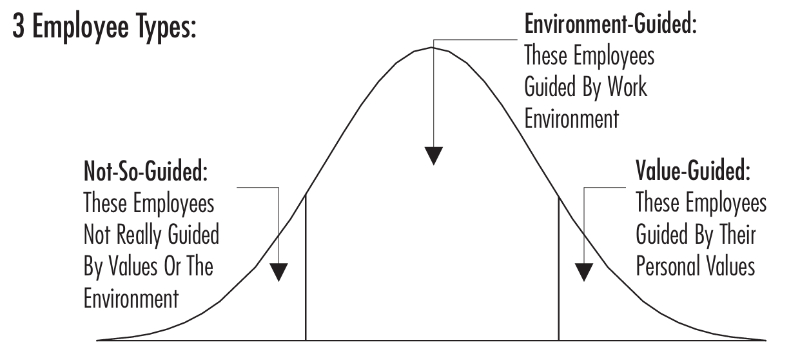
From “The Improvement Toolbox“,
by Keith N. Miles, page 60.
So how does this difference in viewpoint play out between value-guided leaders and their work environment-guided staff?
As staff listen to this quarter’s strategic targets, they hear what’s being said but can’t determine the likely impact to them as they reflect on how their job performance has been (and most likely will be) evaluated, if they were ask about a raise or promotion. As a result, most staff stay frozen, and continue to do precisely what they have been doing. They wait until there is a tangible adjustment in a reinforcing mechanism that affects them. The result is frustrated leaders and confused staff, neither seeing the needed changes being put into action.
Interesting, this dichotomy of values and their affect on behavior has been observed before. Long before.
3,000 years ago, a wise individual, King Solomon, summarized his observation to this exact dilemma in this way,
“Servants cannot be corrected with just words, though they understand, they won’t respond.”
Solomon concluded that though we communicate and employees seem to understand and should understand, they still won’t respond. He said it’s not about words and understanding. That is only the first step. The second and more crucial step is to adjust one or more of the reinforcing mechanisms which affect them so they actually respond!
There are four main ways organizations exert pressure on employees’ roles (outlined in my first book) but in summary, it’s what employees are accountable for that affects their behavior more than any words we might use. This exactly describes my research findings after studying organizational change efforts in 72 organizations for three years.
Solomon, however, didn’t suggest that we stop explaining to people the rationale for decisions and directives, but rather that we should stop expecting them to change their actions in response. Employees deserve to be given as full as practical an explanation for new directions and activity changes as a sign of our respect for their intellects, ideas, and contributions.
Solomon’s wisdom is that presentations alone won’t deliver change, in contrast to ineffective current ‘change’ methods. Yes, present clearly where our organizations is and what everyone needs to do differently to turn plans into outcomes – but don’t stop there. Modify leaders’ and employees’ accountabilities to motivate the daily actions required to make the most of today’s team and to achieve your goals.
A client example illustrates this principle if you care to read farther:
One multi-billion-dollar client organization needed to improve leadership, trust, work-culture, and operational issues across an essential service, 400-person division. Division leaders were so busy they routinely missed their own departmental meetings. Employee satisfaction was the lowest of any division in the enterprise.
Our team distilled 35 different agendas down to common behavioral elements and suggested accountability changes to align leaders’ and later employees’ actions to this simplified five-priority agenda.
In a single two-hour, Tuesday morning session, we presented to division leaders, the now consolidated agenda as well as specific changes to their accountabilities (which would be considered before a bonus or promotion). Included were less-than-radical suggestions such as that leaders should listen to employees, ask for their opinions, and actually attend their own departments’ regular meetings.
Three days later, our meeting coordinator walked through the division’s office area and two employees propelled her into the lunch room, asking, “Our manager went to a meeting on Tuesday morning led by two outside individuals. What did they do to our manager?”
The coordinator didn’t know how to respond. The employees continued saying, “Our manager, finally after over a year, attended our, his own departmental meeting that Tuesday afternoon, and for the first time he listened to us and asked our opinion on things. He scared us half to death. What did they do to our manager?”
She explained the meeting outlined the simplified agenda which included accountable operational and leadership actions like attending departmental meetings and asking for opinions prior to leaders sharing their own.
Here’s the important part. The two employees responded with, “Is this just a speech? Because around here speeches only last a week or two.”
There it is. In many previous instances these employees had seen ‘new’ ideas and initiatives come and quickly disappear. Think Solomon’s ‘just words’.
The coordinator told them no it wasn’t a speech. These leadership behaviors were now included in leaders’ annual performance assessments and that no one would get a raise unless they demonstrated these behaviors over the year.
“Oh,” the employees responded, “then this will work.” Smart folk.
One division leader told us the behavioral impact of that Tuesday meeting (and its accountability changes) remained visible four years later, demonstrated, in part, by sustained, record-setting employee satisfaction scores.
From a single, two-hour roll-out session. Not many words. Significant impact. SMG’s method in action.
Adapted from The Improvement Toolbox, by Keith N. Miles.